
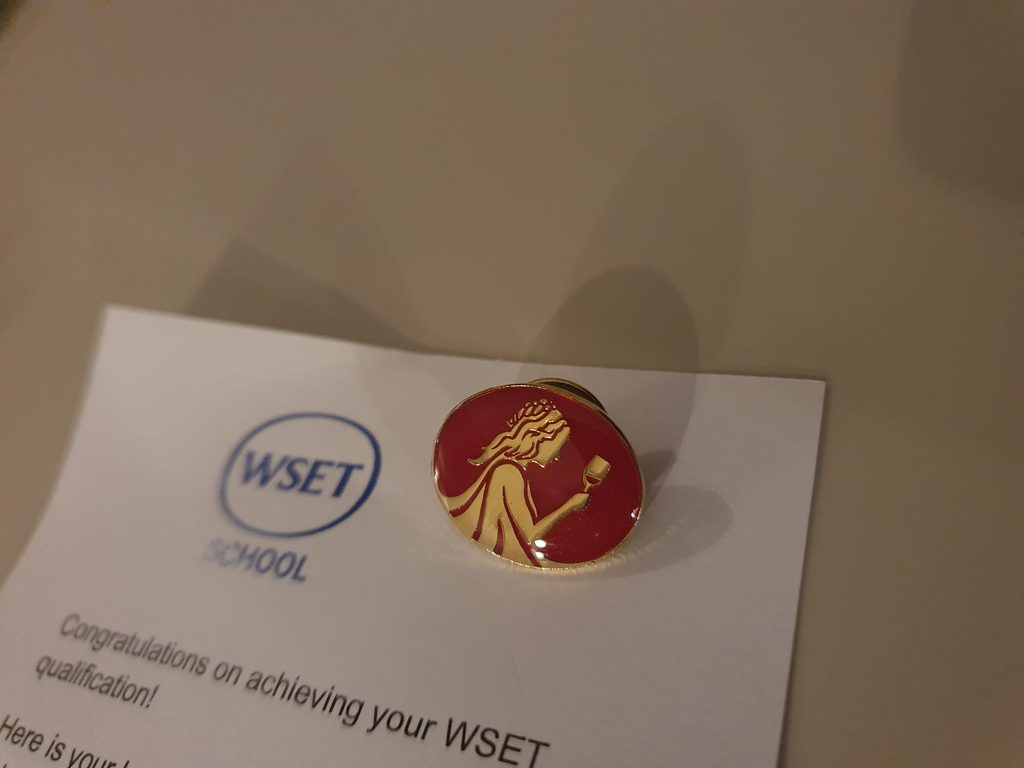
Last month I found out I’d passed the exam of the last unit and finally became a DipWSET. The pin arrived about a week ago.
My WSET Diploma journey began in June 2023. I chose the online pattern simply because in Milan, where I lived back then, there was no WSET school providing the Diploma programme.
The reason why I enrolled in the Diploma programme was not particularly known to me. It just seemed natural for someone working in wine that had just completed Level 3.
At first, I thought being “online” meant we’d have online lessons. Then turned out it was a self-study programme. That was quite a surprise to me, although this had indeed been mentioned in their marketing materials. Self-study aside, students were supported by an online forum where we could post questions and educators would answer. We were also given group assignments on a weekly or fortnightly basis. It was also the online forum where we would submit those assignments. We were encouraged to do the quiz at the end of each subject unit. But nothing was mandatory. Not even the group assignments. Self-motivating was key.
As nearly no one did the Diploma full time, and as nothing was mandatory, you could imagine how our study time dropped as time went on. And how less and less time was spent on the online forum asking questaions and submitting assignments.
But there was one thing that was mandatory: the exam.
In August came my first exam: D1 Wine Production.
20 something chapters on both viticulture and winemaking were concentrated into 3 to 4 questions on the exam paper.
Many argue that you’ll need facts and knowledge outside the textbook to get a distinction. While that may be true, I’d humbly argue that it’d already be a miracle to stuff just the facts and knowledge in the textbook onto your answer sheets in the bare minimum time you’re given on your exam day.
During the exam, I was aware I was writing something down on the paper, but it wasn’t my brain that was in command. It was my adenaline alongside the butterflies in my stomach that was leading my train of thought. In a way, I lost myself in it. In a way, it felt good.
As soon as the invigilator declared “time’s up”, my brain was switched back on and in control again.
We all live in a world where our time here is finite, but we are just fine most of the time. We only turn into an adrenaline overdose or a stomachful of butterflies with the brain switched off when we are reminded that our time is finite. If you’ve never experienced that in your life and would like to and if you happen to be a wine lover, enroll yourself in the Diploma programme. I bet you will not be disappointed.
I learnt I passed D1 just around the time I was to take the D2 exam: Wine Business in October.
With just over 100 pages, this unit was much lighter, but by no means easier, especially the part that detailed the US three-tier distribution system and how each state had its own regulations. Later in my retail role I heard a lot about this complex system from the US customers. One most classic example was customers living in Connecticut would usually travel to neighbouring states to buy wine for better prices and a wider range.
Around New Year 2024, I found out I’d passed D2.
As my D4 and D5 exams would not come up until June 2024, and as my wine consulting business got more demanding, I believe that for a period of time in the first half of 2024, I forgot I was a Diploma student.
D4 Sparkling Wine and D5 Fortified Wine were both under 200 pages. They were two very insightful and delightful subjects. I learnt a great deal about the history of Champagne, Sherry, Port and Madeira. Although these were not my favourite wine styles, I did have the most fun studying about their culture and stories. It was also during my D4 D5 studies that I realised how important a role English merchants had been playing in the global wine trade for centuries.
The D4 D5 exams included tasting. This may sound terrifying, but at WSET, successfully identifying the grape variety isn’t the point. If you assess the quality of the wine correctly but err on what grape it is, you can still pass with flying colours. It’s the quality that counts.
The self-study setting meant I had to source the wines for tasting myself. I did my best to source as many as I could. But there were still a good number missed. In my opinion, you really do not need to taste every single wine suggested by the Diploma Specs to pass the tasting exams. What you need is a solid foundation of tasting skills laid by Level 3. At the end of the day, we are assessing wines in the same approach as in Level 3, with just more detailed explanations required in your tasting notes on the Diploma level.
In August 2024 I was informed that I’d passed D5 but failed D4. I was shocked about failing D4 but even more so about passing D5.
At one point I was about to apply for a re-mark for my D4, but it would cost a couple of hundred pounds. If you aren’t 100% sure you’ll pass after the re-mark, you may as well save that money for a re-sit. As I wasn’t sure, I did not apply in the end.
In total there are 6 units in Diploma. D1 D2 D4 D5 counts as Sememster 1; D3 D6 belongs to Semester 2. These two semesters are paid for separately. Your Semester 2 will not start until you pay for the Semester 2 installment, which means there can actually be a break between the two semesters if you like.
But I did not take that break. My D3 module had already begun by the time I took my D4 D5 exam. And between my D4 re-sit and my D3 exam, I decided to tackle the latter first.
(to be continued)